
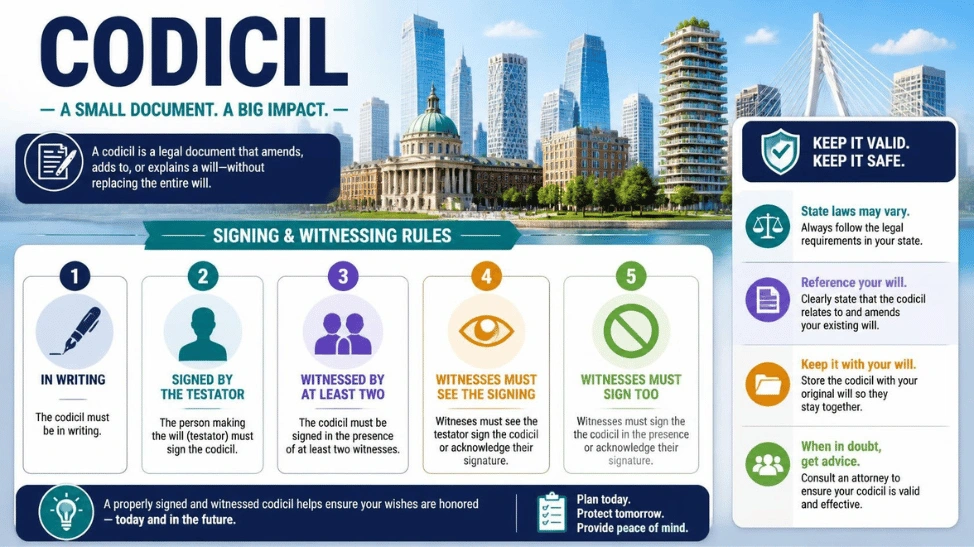
A will may remain unchanged for years, even when your family, assets, or wishes change. You do not always need to replace the entire document when only one part needs updating.
Short answer: A codicil is a separate legal document that changes part of an existing will while leaving the rest in place. It can add, remove, or revise instructions. Because it affects a will, it generally must comply with the execution requirements of the governing law.
| Question | What to Know |
| Main purpose | Change specific instructions in an existing will. |
| Common uses | Replace an executor, alter a gift, or update a beneficiary. |
| Original will | Usually remains effective except where the amendment changes it. |
| Signing | Formal requirements depend on the governing jurisdiction. |
| Best suited for | Narrow, clear changes |
| When a new will may be better | When several provisions need rewriting |
| Main risk | Conflicting, unclear, or improperly executed documents |
For more plain-English legal information, readers can also browse Knosten’s Law section. The site groups its general legal explainers there.
What This Type of Will Amendment Actually Changes
Think of the amendment as an additional legal document, not an edited page of the original will. It can amend or revoke part of a will without necessarily replacing the underlying document.
Suppose your will leaves $10,000 to a relative, but you later want that gift to be $15,000. A properly prepared amendment can identify that provision and replace the original amount with the new one. The remaining instructions can stay unchanged.
Other narrow updates may include:
- appointing a different executor;
- adding or removing a beneficiary;
- changing a specific gift;
- updating a guardian nomination where local law permits; or
- revising a provision that no longer reflects your wishes.
The wording should clearly identify what is changing without creating uncertainty about the rest of the estate plan.
When a Codicil Makes Sense and When It Does Not
This approach works best when the requested update is limited and easy to describe. For major changes, creating a new will may be clearer and easier to manage.
A simple decision table can help:
| Situation | Focused Amendment | New Will |
| Replace one executor | Often suitable | Usually unnecessary |
| Change one specific gift. | Often suitable | May be unnecessary |
| Add one beneficiary | May be suitable | Consider the wider plan |
| Rewrite several gifts | Less attractive | Often clearer |
| Change the overall distribution plan. | Greater risk of confusion | Usually clearer |
| Several earlier amendments already exist. | Adds another document | Can simplify the record |
There is no universal number of changes that automatically requires a new will. The practical question is whether someone could read all the documents later and understand your instructions without having to guess.
How the Amendment and Original Will Work Together
Codicil The original document does not disappear simply because you make a limited update. The executor may eventually need both documents to determine your final instructions.
That can create a version-control issue that many simple definitions overlook. Imagine an original will followed by three separate amendments written years apart. Each may be valid on its own, yet the executor must still determine exactly how the documents interact.
A clean rewrite can be easier when the paper trail becomes complicated. That does not mean every small change requires starting over. It means clarity matters as much as convenience.
Legal procedures can also affect outcomes in other settings. Knosten’s guide to what a mistrial means offers another example of why the effect of a legal event depends on the rules behind it.
Signing and Witnessing Rules Depend on Where You Live
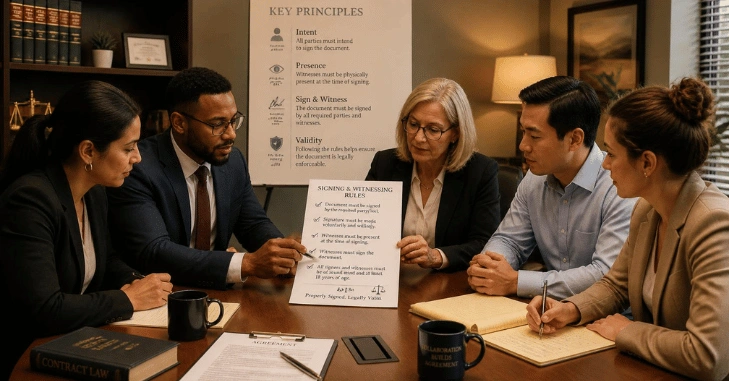
Do not assume that typing a change, signing it, and placing it beside your will automatically makes the update valid. Requirements vary by jurisdiction. Depending on where you live, an amendment may need to follow the same or similar signing and witnessing formalities as the original will.
Local rules may address issues such as:
- how many witnesses are required;
- who may serve as a witness;
- whether electronic execution is allowed;
- whether notarization plays a role;
- mental capacity at the time of signing; and
- special rules for handwritten documents.
This is why a form found online should never be treated as proof that your update complies with local law.
What Can Make a Will Amendment Risky?
The biggest problems usually arise from execution mistakes or unclear instructions. A document may create problems when it fails to meet local signing requirements, identifies the wrong clause, contradicts another provision, or leaves uncertainty about the person’s intentions. The risk increases when several documents modify one another.
Storage can create another problem. An executor who finds the original will but not a later amendment may not have the complete set of instructions.
Keep the documents together or store them in accordance with an appropriate estate-planning arrangement. Make sure the person responsible for your estate knows where the current records are kept.
The broader lesson also applies before signing other legal documents. Knosten’s article on an early settlement offer after a car accident explains why understanding a document’s legal effect before signing it matters.
Amendment or New Will: A Practical Decision Rule
Start by listing every change you want to make. A focused amendment may be reasonable when you can describe the change in one or two precise instructions. A complete rewrite warrants closer consideration when the changes affect multiple beneficiaries, major assets, family circumstances, or the overall distribution plan.
A new will can also reduce the risk of leaving executors with several documents that must be reconciled after your death.
Professional advice may be especially useful when:
- the estate contains substantial or unusual assets;
- family relationships may lead to a dispute;
- someone may question mental capacity or undue influence;
- different states or countries are involved; or
- I’m not sure how the proposed change affects another clause.
Knosten also covers situations in which jurisdiction and legal status can affect the answer, such as when a gun rights lawyer may be needed.
Your Next Step
Codicil Read your current will from beginning to end and write down every provision you want to change. If the list is short, ask an estate-planning professional whether a focused amendment is permitted under your local law. If the changes affect the plan’s structure, ask whether replacing the will would create a clearer record.
Keep the signed documents together or use another appropriate storage arrangement. Make sure your executor knows where the current estate-planning records can be found.
Frequently Asked Questions
Possibly, but being able to prepare your own document does not mean it will satisfy local law. Signing, witnessing, capacity, and wording requirements can vary. A lawyer can be especially useful when the change affects several provisions or could lead to a dispute.
No, not ordinarily. It generally modifies identified parts of the will while leaving the unchanged provisions in effect.
In some jurisdictions, multiple amendments may be permitted. However, using several documents can make the final instructions harder to interpret. At that point, a new will may provide a clearer record.
Reviewing your estate plan after marriage, divorce, the birth of a child, a death, or a major financial change is sensible. The legal effect of those events varies by jurisdiction, so do not assume your existing instructions will still produce the result you want.